

Create reports with the required climate indicators
With IngSoft InterWatt Enterprise CCF, you can determine the required energy & climate key figures that you need to fulfill the legally required reporting obligations, such as the CSRD.
Record all direct and indirect emissions generated in your company and evaluate them separately according to Scope 1, Scope 2 & Scope 3. Several emission factors can be assigned to each medium. Evaluations can also be carried out according to units, media or energy properties.
IngSoft InterWatt also gives you the option of configuring individual reports with the energy and/or climate key figures relevant to you. This means you always have the latest evaluations at your fingertips.
How IngSoft InterWatt simplifies the BISKO process steps
- Delimitation of the balance sheet area:
IngSoft InterWatt flexibly maps municipal structures - from the entire municipality to individual properties, districts or departments - thanks to freely configurable organisational units. - Determination of the balance sheet year:
The complete historicisation of all data and structures means that balance sheets can be reliably created and compared for any period of time. - Data collection:
Consumption data is collected from various sources - from automated loggers and energy supplier bills to manual recording via app (incl. OCR meter reading recognition). - Data preparation:
Activity data can be clearly assigned to the BISKO sectors and energy sources. Energy factors such as area or user numbers can be historicised and maintained for each property. - Calculation of emissions:
emission factors (according to UBA or individually) are managed centrally, historicised and automatically included in the emission calculations - including differentiation according to Scope 1-3. - Finished report and documentation:
With the help of our report templates, all analyses can be combined into a finished BISKO report. The documentation can also be created using the software.
Role-based work - clearly regulated, efficiently implemented
Another success factor is the possibility of collaborative use: the granular rights system in IngSoft InterWatt enables you to involve other colleagues from specialist departments such as transport, waste management or building management in the implementation within the software. Each person receives exactly the access rights they need - no more and no less.
IngSoft InterWatt was also developed as a highly scalable and multi-client capable application. This makes it possible for the software to be used by several clients - separately from each other: Ideal for integrating municipal holdings, in-house operations or external partners.
Conclusion
Reduce emissions in your municipality with IngSoft InterWatt and BISKO
IngSoft InterWatt provides municipalities with a powerful tool for energy and climate management: The software not only fulfils the requirements of municipal energy management, but also considerably simplifies greenhouse gas balancing for your municipality.
Data is not only collected, but also utilised intelligently. Processes are not only documented, but controlled in a targeted manner. And measures are not only effective internally, but can also be proven externally - transparent, comparable and future-proof.
With BISKO as a methodological foundation and IngSoft InterWatt as a digital tool, municipal energy and climate managers are ideally equipped to reduce their municipality's greenhouse gas emissions and thus make an important contribution to climate protection.
Would you like to find out more?
We would be happy to give you a free insight into how our IngSoft InterWatt software supports the implementation of a GHG balance sheet in accordance with BISKO. Feel free to contact us!
1www.hamburg-institut.com/leistungen/klimaneutrale-kommunen/
Events
All eventsNews
All news
Up to €28,000 in funding for local authority energy management in Bavaria

Never miss anything again! Subscribe to our newsletter now:
IngSoft InterWatt makes it quick and easy to achieve a municipal greenhouse gas balance
Municipalities play a decisive role in achieving climate targets. As operators of public buildings, infrastructures and mobility services, they have considerable opportunities to influence the reduction of greenhouse gas emissions. In order to realise this potential, BISKO has developed a uniform standard for the preparation of municipal greenhouse gas balances. However, implementation is time-consuming: Data from different sources must be collected and processed. Find out how our IngSoft InterWatt software makes your work easier.
Standardised methodology as a foundation
BISKO provides local authorities with a standardised and sustainable system for compiling greenhouse gas balances in a comprehensible and comparable manner. All relevant sectors are included - from energy consumption, transport and, optionally, waste management to water/wastewater, land use and agriculture.
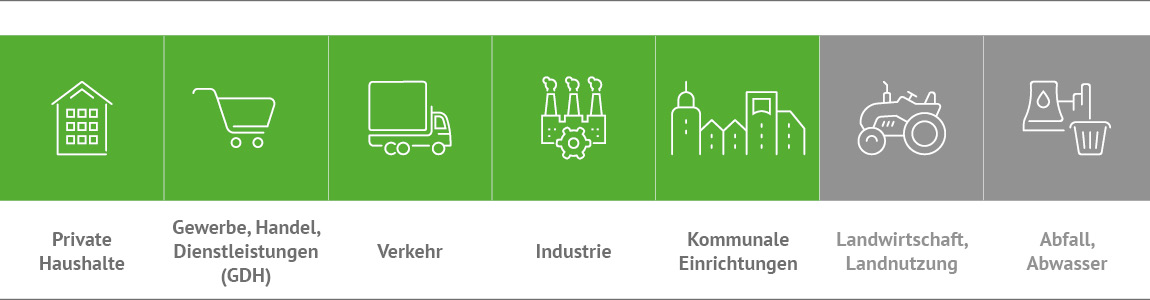
Illustration based on Hamburg Institute1
The BISKO system is continuously being developed - also with regard to new legal requirements and international standards. These include, for example
- the consistent separation between territorial and polluter-pays accounting,
- the integration of Scope 1 to Scope 3 emissions,
- and the centralised emission factor database of the Federal Environment Agency.
These standards not only increase comparability, but also make climate management more compatible for local authorities as a whole.